Platform Paralysis

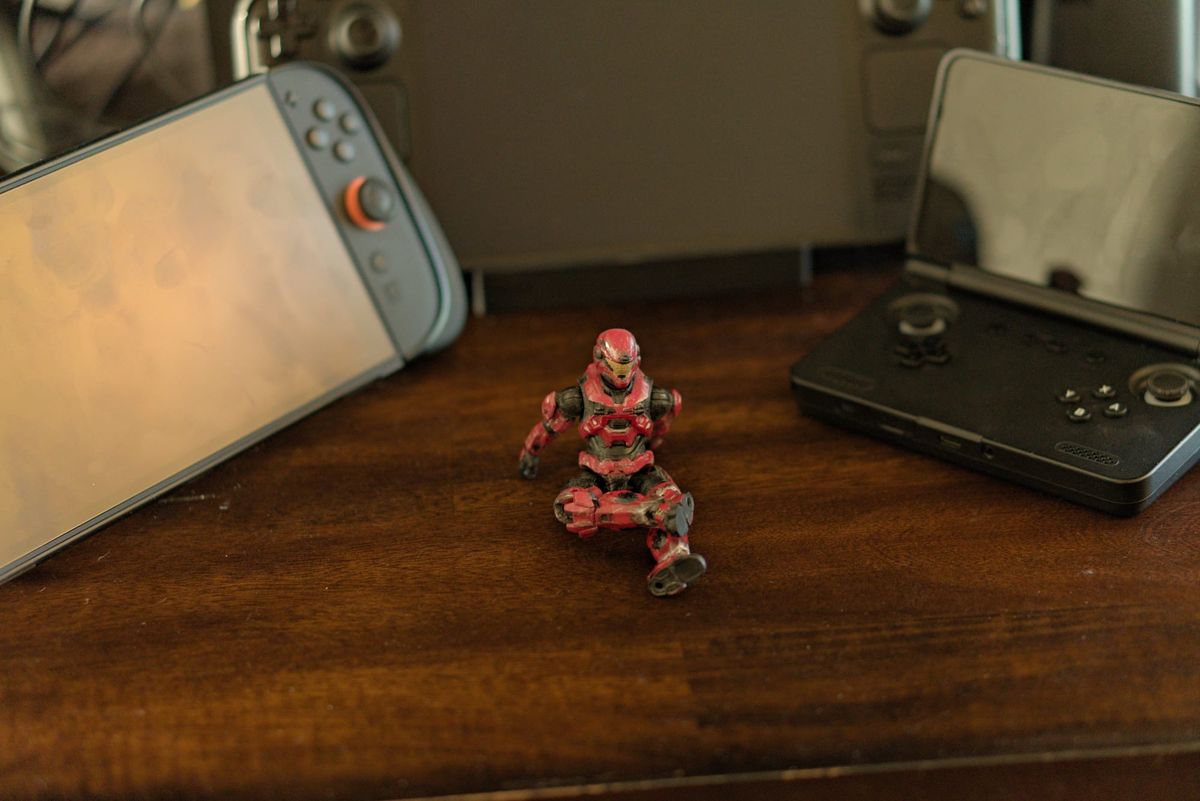
Like many people who have been gaming for years, I have acquired a number of devices over time. Currently, I have:
- Gaming desktop
- Gaming laptop
- Steam Deck
- Nintendo Switch
- Nintendo Switch 2
- Retroid Pocket Flip 2
- PlayStation 4
- Xbox 360
That's a lot of gadgets. As someone who aspires towards a minimalist's lifestyle, this would seem to be too many devices. Unable to stop myself from min-maxing almost everything I do, I'm often stuck with a hard question when I want to play a game. What device should I play it on? Naturally, there are differences between all of these devices. Differences like game library, performance level, input methods, user experience, and etc. Not every game I have is equally compatible across all these systems, but a lot of the time I still end up having multiple options to choose from. This is particularly true for my PC based devices which all have access to my Steam library. When any one of those devices can run the game I'm interested in, which one is best to play on? It's a stupid, 1st world problem... but it plagues me.
Basic Metrics
There are a few metrics I use to estimate the answer: performance, portability, competitiveness, user experience, cost of games, and any odd quirks about a specific platform. Here is how I rank my most commonly used devices on those metrics:
Performance: desktop > laptop > Switch 2 > Steam Deck
Portability: Steam Deck == Switch 2 > laptop > desktop
Competitiveness: laptop > desktop > Steam Deck > Switch 2. Laptop comes before desktop because it has a 165hz display instead of my desktop's 144hz, and the panel technology it uses doesn't have any ghosting unlike my desktop's VA panel.
User Experience: Switch 2 > Steam Deck > laptop (linux) > desktop (Windows).
Cost of games: Steam Deck == laptop == desktop > Switch 2. Steam vs Nintendo pricing, need I say more?
Odd Quirks:
- The desktop runs Windows, which I generally just don't like to use as a personal preference. Additionally, the display it's hooked up to has a VA panel, which has a number of issues like ghosting.
- The laptop (a Framework 16) has power delivery issues that can make demanding workloads equal parts gaming and troubleshooting. E.g. 1% lows diving off a cliff if the battery isn't fully charged while plugged in.
- The Steam Deck doesn't have a 2nd usb port, which makes it difficult to make use of my wireless headset for Discord w/o relying on battery power. It also really struggles with 4k output (sometimes in non-obvious ways), unlike the Switch 2 which seems to handle 4k quite well.
- The Switch 2 doesn't support many of the games I'm interested in.
One thing I'll also note, is that since I started drafting this post the Steam Controller has released, and it has drastically helped close the user experience gap between Steam Deck and Switch. I may talk more on that in a future blog post.
A wrench in the plans
In theory I can take those above metrics and optimize for whatever experience I'm looking for... but if you've read this far, you know it's not that simple.
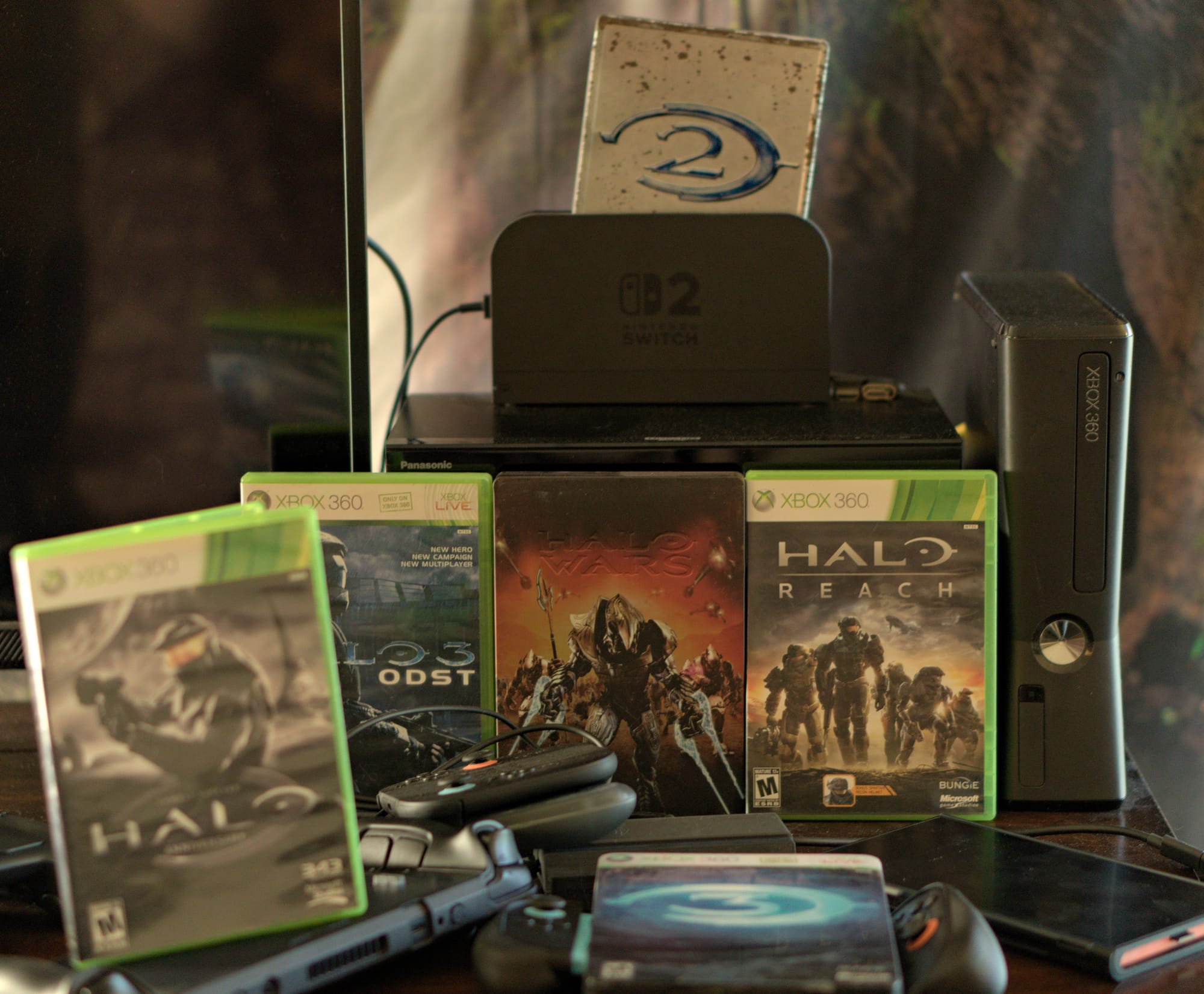
The other day, me and my SO were trying to play Halo. She had only played through Halo 3 once before, so we decided to try making our way through the (Bungie-era) Halo's together via Master Chief Collection on PC. The plan was CE-3, then ODST and Reach. We got as far as entering the bridge where Captain Keyes gives you the magnum for the first time... except we didn't get that far. Upon entering the bridge, the guest client (whomever happens to be player 2) would freeze up. We tried all sorts of things, but never got past that issue, so we tried skipping forwards to Halo 2. We had almost completed the second level before one of our games crashed. A relaunch and reconnect later, it wasn't long before the game crashed again. At that point, she called it quits. The co-op campaign was officially deemed "unplayable", in the manner that we were unable to play and progress in it.
We were both incredibly disheartened by this, after all I'm known as a huge Halo nerd and she wanted to experience some of that with me. Thankfully, I still had an old Xbox 360 with disc copies of all the Halo games. The next day, I set that up and within moments we were off to the races, fighting covenant and exploring ring worlds. At some point while playing, it occurred to me that if I didn't have the disc copies of the game we would've been entirely unable to play this together. One of the most legendary games of all time, rendered inert by time and software bugs in MCC.
That's when I also started putting two and two together, and took a look at my Steam library comprised entirely of license keys rather than actual ownership. I owned my physical copies of Halo. A week of hyper fixation later, and I realize that even if I wanted to say that physical game copies are the answer to the problem of game ownership/archival, in the sense of being able to play any game 20 years from now... I'm a little late to that party. Practically my entire library is on Steam, and even if I migrated to a console that supports physical copies like the Switch 2 or PS5, they've started moving away from true physical copies by now. Many if not most releases seem to simply be licenses on the media, and that's if there's an actual product in the box. Sometimes, it's just a box with a slip of paper with a license key printed on it!
Let's put that aside for a second though, and suppose that wasn't an issue. I went down this rabbit hole because I loved playing Halo when I was younger, and was concerned about being able to continue playing it in the future. But, Halo wasn't a great game because it was a physical game, it simply was great. If the Master Chief Collection had been the original release of the game, and I had the same co-op experience as I did recently, I simply wouldn't have the same fond memories with it as I do now. That speaks more to the quality of the game/software than the medium through which it is sold. Game's may be more incentivized to be polished on release with a physical copy, sure, but ultimately the issue I was chasing was more related to game quality than the nuances of ownership.
So where does physical media stand in my world? I think it's something worth considering. Getting a (true) physical copy of a game has a number of benefits such as being resell-able, tradable, borrow-able, won't be lost if your account gets banned or the servers go offline, and it can be tied to a specific hardware/software system that's guaranteed to run it which is not something than can be said of PC. Anyone who's tried to play Fallout 3 on PC (Windows) lately knows the pains of Games for Windows Live dependencies.
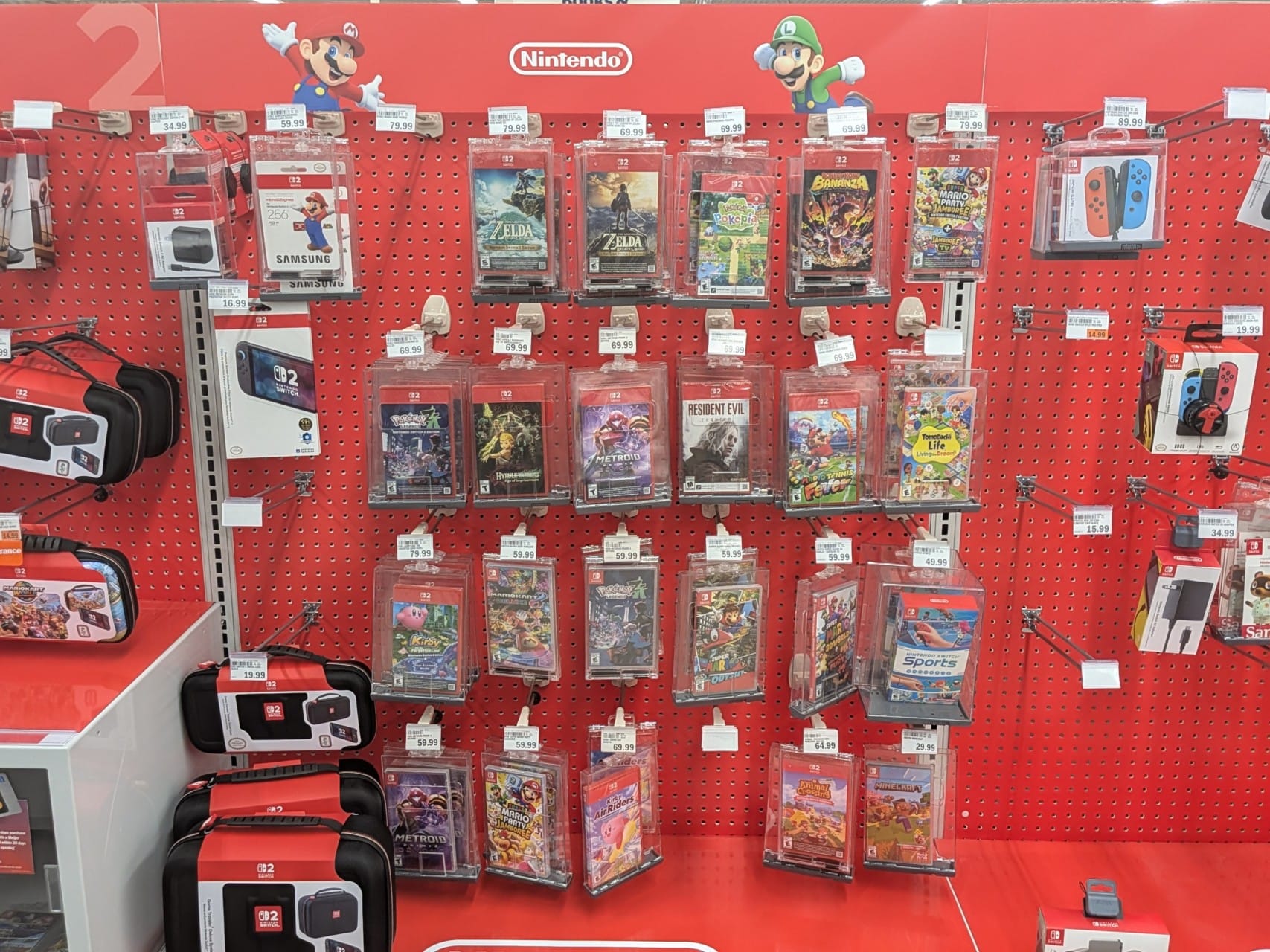
During my hyper-fixation on physical copies, I went shopping specifically for games on Switch 2 that had physical editions and ordered 2 games: Chromagun 2 and Outbound. Chromagun actually ended up being a really good game, a love letter to the Portal series, and in my opinion just about as good. I'll probably do a separate review of it at some point. Were it not for the physical release, I never would've found it. The old-school process of shopping via box art was actually a ton of fun (if judgemental)! However, I later realized that I was paying 2x the cost of the game on Steam to get a physical cartridge for switch. $50 for a $20-25 game doesn't feel so good. I ended up canceling my pre-order for Outbound and bought it on Steam for half the price, especially after I saw the reviews for it were a little polarized. It's also a co-op game, and no one I play with was going to pick it up on Switch when they're all PC players.
Where does this leave us?
That's all a long winded explanation of dancing around a topic without really answering the question of what platform do I buy for, and where do I play it? To wrap up this post, I've created some flow charts to help visualize my thought process. Thanks to the folks in PolaDr0id's discord channel for helping me polish them up 😄.
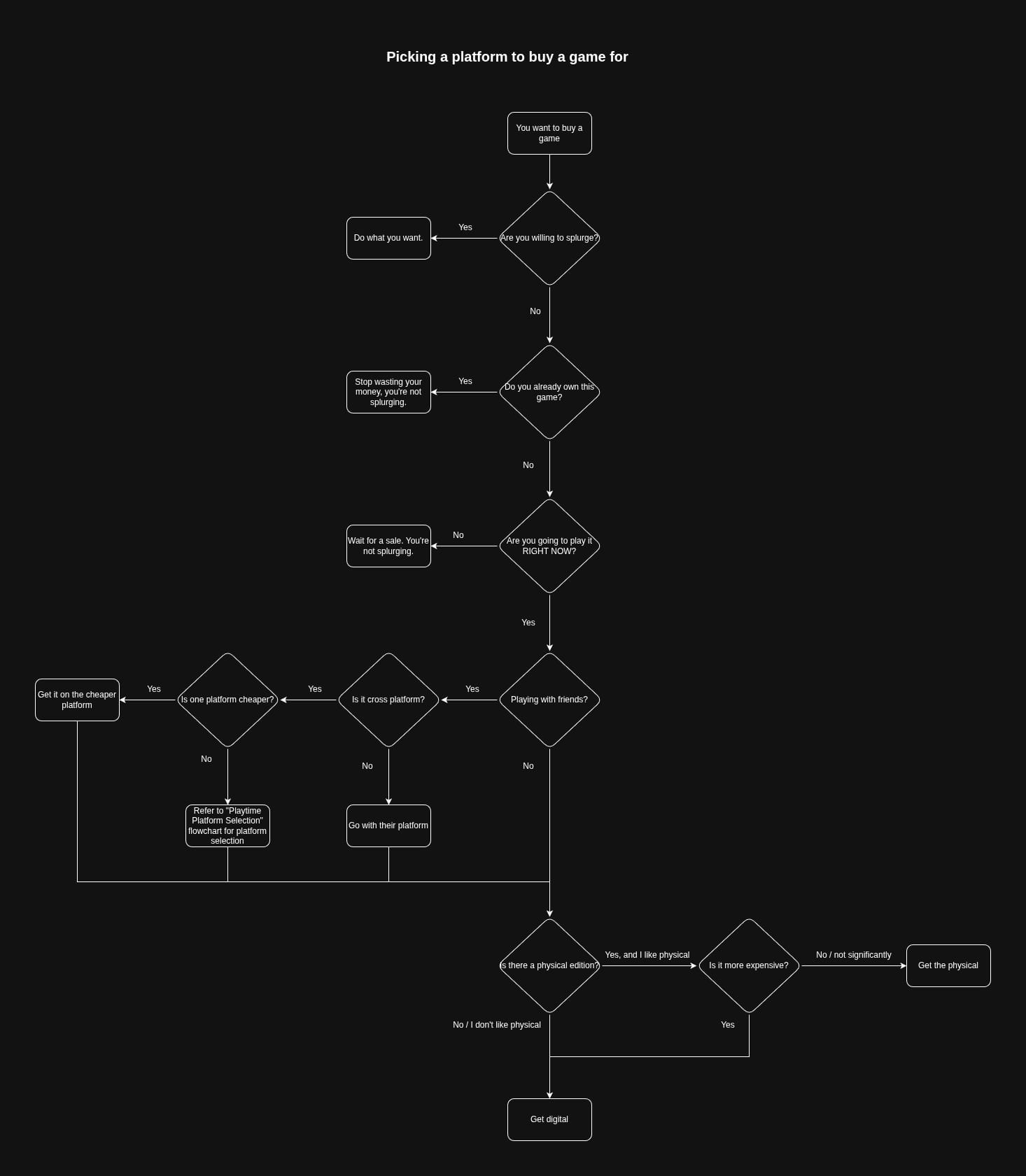
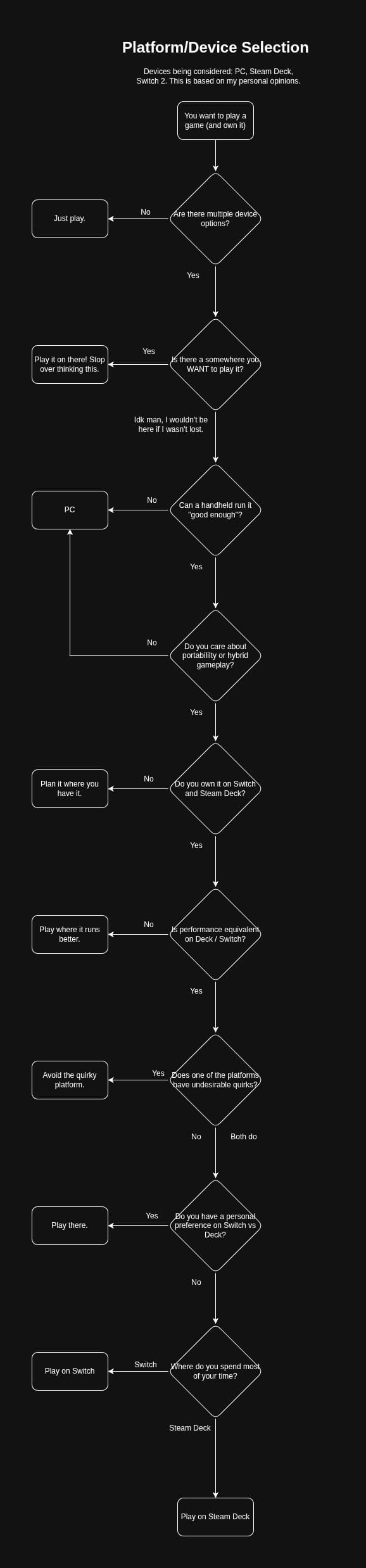
My opinions on the content in here have changed many times, and they're to change again. As it stands today however, this is where I'm at. All that is to say, nothing in this post really matters though. To paraphrase a favorite YouTuber of mine (PolaDr0id): The best platform might simply be the one that makes you want to play.